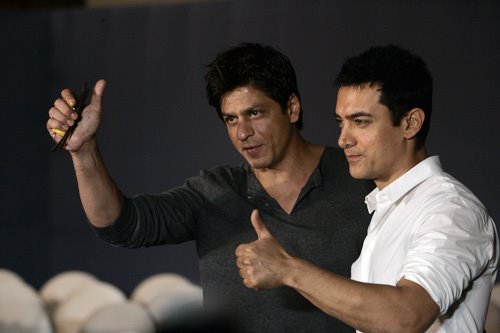
The Hindi film industry has come to a grinding halt. The standoff between multiplexes and producers and directors is still on and there seems no end in sight. On the evening of April 7, filmmaker-actor Aamir Khan, actor Shah Rukh Khan and filmmakers Karan Johar, Yash Chopra, Ronnie Screwwala addressed the media about the ongoing strike. This is the text of Aamir Khan's speech.
Today is not a happy day for us. It is our responsibility, as the film industry, to entertain people. But there are certain issues in front of us that prevent us from doing that. We won't be able to run our films at multiplex chains across the nation. As entertainers, it is our responsibility to be honest to our audience. And that is why we are here. We all feel very bad but it's important for us to convey to our audience why we are doing what we are doing and why some of our audience won't be able to see films for a while.
The most important issue right now is that producers, distributors and all of us believe that this is one industry where everyone can earn and survive. That is our primary thought. Every sector of the industry has to earn what it deserves. Till that happens, I don't think the industry can be healthy and happy. All of us producers and distributors think that if any sector, including the exhibition sector is not happy and healthy, then the film industry as a whole will not be healthy and happy.
How it works
Traditionally, what has happened is that a producer makes a film; the distributor buys it from him and sells it to the single screen theatres where they run it for audiences to see. Our seniors like the late Raj Kapoor and the late BR Chopra and others started a system where the creative or production side kept a share of the profit and passed the film to the distributor. Traditionally, the distributor and exhibitor had an understanding of profit sharing at 80:20 where the distributor kept 80 per cent and the exhibitor kept 20 per cent. At some places the ratio was 70:30 or 65:35. That was the tradition. Our seniors must have found something viable in this ratio because the industry has followed this tradition for years. In my mind, the value and respect we have for creative minds is in favour of the greater good.

Required change
But now, things are changing. We have corporate companies among us, in the production and exhibition sector. We value and respect the change the multiplexes have brought in. They have built multiplexes with a lot of hard work and expertise and we value and respect that. I feel happy that my film is being screened in an environment where the sound is good, quality of screening is good and the food is good. So the traditional formula of 80:20 needs to be redefined. We need to understand and value what the new multiplexes are bringing in and share much more with them than we did traditionally because there is a lot of investment in the exhibition sector.
The change that is required. Every sector, be it the multiplexes or the producers, everyone makes an investment. In the film industry, things are changing with the corporate companies coming in the creative and exhibition sector. Some people will make films while the others will show films. There is a huge investment and effort from the sections: the creative section and the exhibition section. My common sense says that it should be a partnership of equals even though creative people may think that they are crazier and greater than everyone else. As a creative person, I want that equality and I feel that two people need to shake hands: one person makes the film and the other exhibits it. A fifty percent partnership of equality is what I think is fair.
Partnership of equals
In the 50 per cent share, the multiplex has to figure out how to make the business affordable and profitable for them. The distribution and production side has also figure out how they will derive profit from their 50 per cent share. Even if I make a film at a budget of Rs 500 crore or Rs 1,000 crore, I cannot go the multiplex and ask for an 80:20 share. It is my problem to figure out the profit. This is a partnership of equals. As far as affordability is concerned, my investment is my problem as a producer, my investment is my problem as a distributor and my investment is my problem as an exhibitor. I have to make my business viable and reduce costs accordingly. The person who doesn't do that needs to bear the brunt of it.
Many times, I have heard that films haven't lived up to expectations because of poor content. No producer thinks or wants to make an exceptionally bad or flop film. We all persevere to make good, entertaining and successful films. When I was young, I would see my father making films. As I grew up, I wanted to become an actor. My family told me not to enter this line because it is a very volatile business; one day you are on top, the next you are not and one film may do well while the other won't. There is no stability or consistency. My parents asked me to join a steady profession like engineering or accountancy. That was the concern of my parents but I came here because I loved films and filmmaking. All of us here love films.
I think it is very important for the new entrants in this business like the national multiplex chains to understand the volatile nature of this business. No matter how hard you work, you will know the result only on a Friday. Even after a few weeks of its release, you will wonder that why your film didn't work in spite of it being a good film. Mera Naam Joker was a very good film, but it didn't work and there is no reason (why it did not work). The newcomers need to understand that there is no steadiness here and you can't exactly predict the fate of a movie. There is no steady flow of business. This business needs heart, emotion and we need to know that there is no specific or particular reason as to why films work or don't work.
Tough stand on multiplexes
A few days ago, we were calculating how multiplexes have contributed to our business and made films more successful. We realised that the gross and net figures are bigger but the distributors' share is the same before and after the entry of multiplexes. No matter how big or small the film, it has made no difference to the share of the distributor. So where has the business increased? It is not for the production or distributions sector. As an industry, we need to understand what the multiplex issues are that are bordering on illegal like the INR being charged at 1 per cent instead of 2 and the entertainment tax being levied where it isn't supposed to be. We have to deal with these practices very seriously.
My suggestion as a member of the industry is to find a solution. Attempts have been made through negotiations. I would recommend strongly that before we set up a committee for the producers' and distributors' side and from the multiplex's side, we need to set up a committee that does research on the problem and finds a solution. This solution should be presented to the two committees. At this time, we should not be fighting and we should unite to find a solution that is fair and contributes to every sector.
Comments